
Vietnam E-Visa Multiple Entry 90 Days: Complete Guide for Tourists, Business Travelers & Frequent Visitors
Introduction
Vietnam has become one of the most attractive destinations in Asia for tourists, business travelers, investors, digital nomads, and overseas visitors. With beautiful landscapes, dynamic cities, growing business opportunities, and convenient international connections, more foreigners are choosing Vietnam for both short-term and repeated visits.
One of the most convenient visa options today is the Vietnam E-Visa Multiple Entry 90 Days. This electronic visa allows eligible foreigners to enter and exit Vietnam multiple times within a maximum validity period of 90 days. It is especially useful for travelers who plan to visit Vietnam, leave for nearby countries, and return again without applying for a new visa each time.
According to the official Vietnam Immigration e-visa system, Vietnam e-visa can be valid for up to 90 days and may be issued for single or multiple entry. Foreigners outside Vietnam can apply personally online or through requesting agencies and organizations.
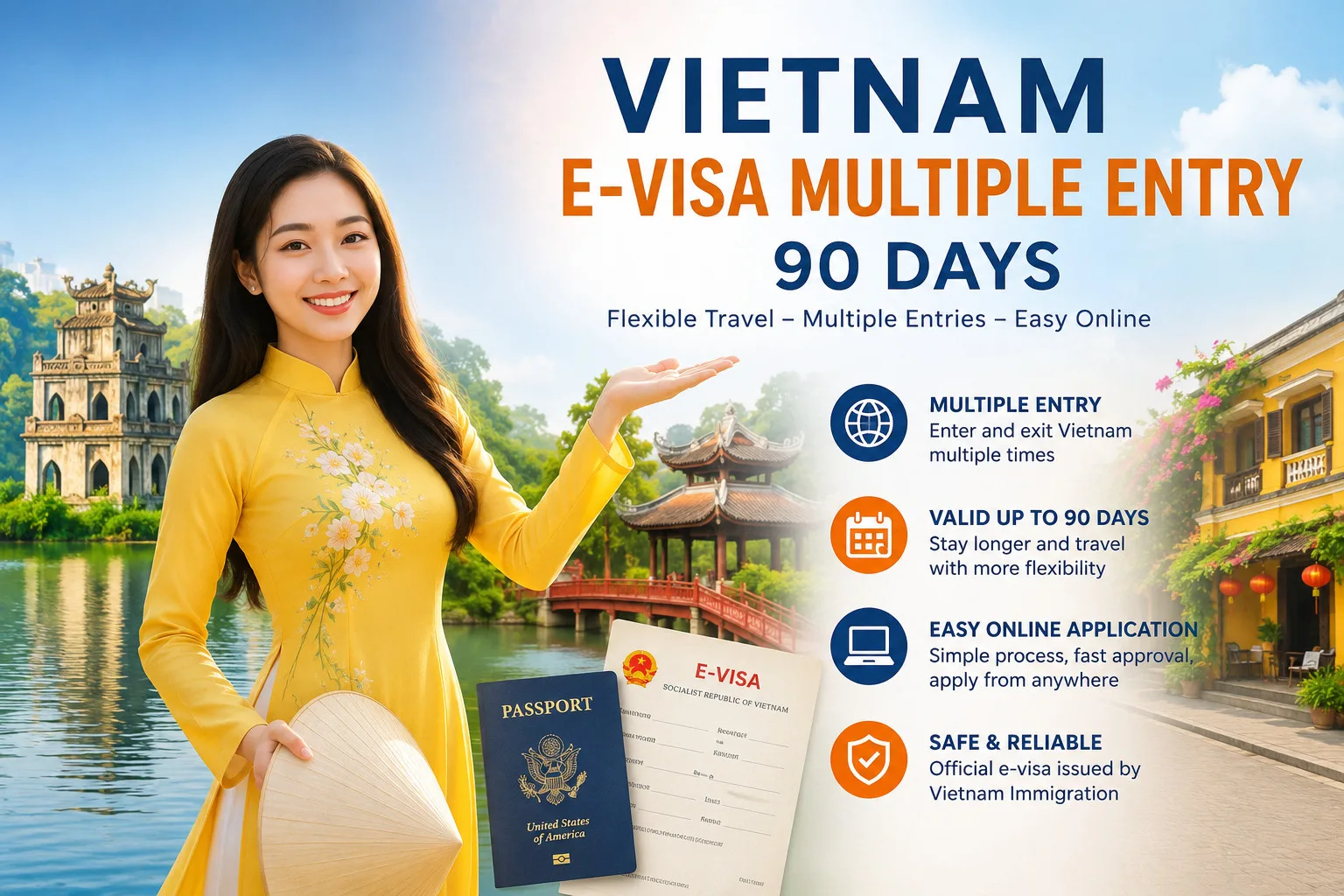
What Is Vietnam E-Visa Multiple Entry 90 Days?
A Vietnam E-Visa Multiple Entry 90 Days is an electronic visa issued by the Vietnam Immigration Department through an online system. Instead of visiting an embassy or consulate, applicants can submit their information, upload required documents, pay the visa fee, and receive the visa result online.
The key benefit of a multiple-entry e-visa is flexibility. During the validity period, travelers may enter Vietnam more than once. This is very useful for people who need to travel between Vietnam and other countries such as Thailand, Cambodia, Laos, Singapore, Malaysia, South Korea, Japan, or China.
For example, a traveler may arrive in Hanoi, stay for two weeks, fly to Bangkok for a business meeting, then return to Ho Chi Minh City without applying for a new Vietnam visa. As long as the e-visa is still valid and the traveler follows the permitted entry conditions, multiple entries are allowed.
Who Should Apply for a 90-Day Multiple Entry Vietnam E-Visa?
The 90-day multiple-entry Vietnam e-visa is suitable for many types of foreign visitors.
Tourists planning a long Vietnam trip
Vietnam is a long country with many famous destinations such as Hanoi, Ha Long Bay, Ninh Binh, Da Nang, Hoi An, Nha Trang, Da Lat, Ho Chi Minh City, Phu Quoc, and the Mekong Delta. A 90-day visa gives tourists more time to explore the country comfortably.
Business travelers
Foreign businesspeople often need to attend meetings, visit factories, meet suppliers, inspect projects, or negotiate contracts in Vietnam. A multiple-entry visa helps them travel in and out of Vietnam more conveniently.
Frequent regional travelers
Many visitors combine Vietnam with other Southeast Asian countries. A multiple-entry e-visa is ideal for travelers who want Vietnam to be part of a multi-country itinerary.
Overseas Vietnamese family visitors
Foreign passport holders visiting relatives in Vietnam may need a longer stay or multiple entries. A 90-day e-visa can be a practical option depending on their travel plan.
Digital nomads and remote workers
Vietnam is increasingly popular among remote workers because of affordable living costs, good food, fast internet, and vibrant cities. A 90-day e-visa gives more flexibility for medium-term stays.
Main Benefits of Vietnam E-Visa Multiple Entry 90 Days
The biggest advantage is convenience. Applicants can complete the process online without submitting their passport physically. The official e-visa system allows applicants to fill in the form, complete payment, and receive the e-visa result online.
Another benefit is cost efficiency. For people who need to enter Vietnam more than once, applying for one multiple-entry visa is usually more practical than applying for several single-entry visas.
The visa also provides better travel freedom. Travelers can leave Vietnam and return during the visa validity period without restarting the application process.
Vietnam E-Visa Validity: How Long Can You Stay?
Vietnam e-visa may be issued for a maximum validity of 90 days. However, travelers should carefully check the exact validity dates printed on their approved e-visa. The validity period is counted according to the dates granted on the visa, not necessarily from the actual date of arrival.
For example, if your e-visa is valid from March 1 to May 29, you can enter Vietnam during that period. If you enter Vietnam later, such as March 20, your visa still expires on May 29. You do not automatically receive 90 days from your arrival date.
The official FAQ also notes that the validity period of an electronic visa cannot exceed 90 days.
Single Entry vs Multiple Entry Vietnam E-Visa
A single-entry e-visa allows one entry into Vietnam. Once you leave Vietnam, the visa is no longer valid for re-entry, even if the expiry date has not passed.
A multiple-entry e-visa allows several entries within the approved validity period. This is the better choice if you plan to leave Vietnam and return again.
If your travel plan is simple and you only enter Vietnam once, a single-entry visa may be enough. But if you are unsure about your schedule or may travel to another country during your stay, a multiple-entry e-visa is safer and more flexible.
Vietnam E-Visa Fees
According to the official immigration e-visa application page, the fee is USD 25 for single-entry e-visa and USD 50 for multiple-entry e-visa. The official system also states that the application is generally processed in 3 working days.
Applicants should note that government fees are usually non-refundable if the application is refused, incorrect, duplicated, or submitted with wrong information. Therefore, all details should be checked carefully before payment.
Required Documents for Vietnam E-Visa Application
To apply for a Vietnam e-visa, applicants usually need:
- A valid passport
- Passport information page image
- Portrait photo looking straight, without glasses
- Personal information
- Travel information
- Intended entry and exit dates
- Entry and exit ports
- Valid email address
- Online payment method
The official e-visa instruction page states that applicants need to upload the passport data page image and a portrait photo looking straight without glasses.
Your passport should be valid for the full travel period. In practice, travelers should also ensure that their passport has sufficient validity and blank pages before entering Vietnam.
How to Apply for Vietnam E-Visa Multiple Entry 90 Days
Step 1: Prepare your documents
Before starting the application, prepare your passport scan, portrait photo, travel plan, entry port, exit port, and payment card.
Step 2: Access the official e-visa system
Applicants can apply through the official Vietnam National Electronic Visa system. The process includes filling out the application form, completing payment, and receiving the e-visa online.
Step 3: Fill in personal information carefully
Enter your full name, date of birth, nationality, passport number, passport expiry date, gender, and other required information exactly as shown in your passport.
Step 4: Choose multiple entry
When selecting visa type, choose the multiple-entry option if you need to enter Vietnam more than once.
Step 5: Select validity dates
Choose the intended visa validity period. Make sure the dates cover your full travel plan, including all entries and exits.
Step 6: Upload required images
Upload a clear passport data page and a suitable portrait photo. Blurry, cropped, shadowed, or incorrect photos may delay or affect the application.
Step 7: Pay the visa fee
Complete the online payment. For multiple-entry e-visa, the official fee is USD 50.
Step 8: Check your result
After submission, use your registration code and information to check the result. Once approved, download and print your e-visa or save a digital copy.
Processing Time
The official application page states that the e-visa application is processed in 3 working days.
However, travelers should apply earlier if possible. Processing may take longer during weekends, public holidays, peak travel seasons, or if the application contains errors.
For urgent travel, applicants should check their information very carefully before submitting. A small mistake in passport number, name, date of birth, nationality, or entry date may cause serious travel problems.
Common Mistakes to Avoid
Many Vietnam e-visa problems happen because of simple mistakes. The most common errors include:
- Wrong passport number
- Incorrect full name order
- Wrong date of birth
- Wrong nationality
- Wrong passport expiry date
- Poor-quality passport image
- Unsuitable portrait photo
- Choosing single entry instead of multiple entry
- Selecting incorrect entry port
- Applying too close to the travel date
- Forgetting to check the visa validity dates
Before submitting your application, compare every detail with your passport. Do not rely on memory.
Entry and Exit Ports
Vietnam e-visa holders must enter and exit through permitted international border gates, airports, seaports, or land ports. Travelers should select the correct entry and exit port in the application.
If your travel plan changes, you should check whether your new port is accepted for e-visa entry. Choosing the wrong port may cause difficulties at immigration.
Can You Extend a Vietnam 90-Day E-Visa?
Visa extension rules may change depending on current immigration policy and individual cases. In many situations, foreigners who want to stay longer may need to leave Vietnam and apply for a new visa, or contact a qualified visa support agency for updated guidance.
Because immigration rules can change, travelers should check the latest official information before making long-term plans.
Vietnam E-Visa Multiple Entry for Business Travel
For business travelers, the 90-day multiple-entry e-visa is very convenient for short business trips, meetings, market research, trade visits, and project discussions.
However, an e-visa is not the same as a long-term work permit or temporary residence card. Foreigners who plan to work, receive salary in Vietnam, or stay long-term for employment should check the correct legal procedure.
Vietnam E-Visa Multiple Entry for Tourism
For tourists, this visa is ideal for flexible travel. You can visit northern Vietnam, travel to another country, and return to central or southern Vietnam later.
A sample itinerary may include:
- Week 1: Hanoi, Ninh Binh, Ha Long Bay
- Week 2: Da Nang, Hoi An, Hue
- Week 3: Thailand or Cambodia
- Week 4: Return to Ho Chi Minh City and Mekong Delta
- Final days: Phu Quoc or Da Lat
With a multiple-entry visa, this type of travel plan becomes much easier.
Important Tips Before Traveling to Vietnam
Always print your approved e-visa before departure. Some airlines may ask to see your visa before boarding.
Check that your passport number and personal information on the e-visa match your passport exactly.
Make sure your arrival date is not earlier than the visa start date.
Make sure your departure date is not later than the visa expiry date.
Keep a copy of your e-visa on your phone and email.
Book flights according to the visa validity period.
If you are unsure about your application, ask for professional support before submitting.
Why Use Professional Vietnam E-Visa Support?
Although many travelers can apply by themselves, professional support can help reduce mistakes, especially for urgent cases, business travelers, elderly applicants, families, or people applying for multiple passengers.
A visa support service can help check documents, review information, guide photo requirements, advise on visa type, and follow the application process.
This is especially useful if you need a 90-day multiple-entry visa and your travel schedule includes several entries and exits.
Conclusion
The Vietnam E-Visa Multiple Entry 90 Days is one of the most flexible and convenient visa options for foreigners visiting Vietnam. It allows eligible travelers to enter and exit Vietnam multiple times within a maximum validity period of 90 days.
This visa is suitable for tourists, business travelers, regional visitors, family visitors, and frequent travelers who need flexibility. The application can be completed online, and the official fee for multiple entry is USD 50.
To avoid delays or rejection, applicants should prepare clear documents, enter passport information accurately, choose the correct visa type, select suitable validity dates, and apply early before travel.
For anyone planning to visit Vietnam in 2026, the 90-day multiple-entry e-visa is a practical solution for smooth, flexible, and convenient travel.
Contact for Urgent Visa Support
- Hotline / WhatsApp / Zalo: +84986979330
- Email: support@vietnamevisaservice.vn
Note: vietnamevisaservice.vn is a commercial/personal website, NOT an official government website. We operate as a private agent and charge a fee for application services. If you do not require our simplified forms and visa application support, you can apply directly on the official government website.