
Applying for a Vietnam E-Visa: Common Mistakes to Avoid in 2026
Applying for a Vietnam e-visa is one of the most convenient ways for foreign travelers to enter Vietnam for tourism, business, visiting relatives, short-term work trips, conferences, or emergency travel. Instead of visiting an embassy or waiting for visa approval letters, applicants can complete the process online, pay the government fee electronically, and receive the e-visa result through the official Vietnam e-visa system.
Vietnam’s electronic visa is issued through the online immigration system and may be valid for up to 90 days, with single-entry or multiple-entry options depending on the applicant’s selection and approval. Foreigners outside Vietnam can apply personally or through requesting agencies and organizations. The official process generally includes filling in the application form, uploading the required passport and portrait images, paying the e-visa fee, and checking the result online.
However, many travelers still face delays, amendment requests, rejected applications, or boarding problems because of simple mistakes. A Vietnam e-visa application must match the traveler’s passport and travel plan accurately. Even a small typo in the passport number, date of birth, full name, nationality, entry date, or port of entry may create serious issues at the airport or border checkpoint.
This guide explains the most common mistakes when applying for a Vietnam e-visa and how to avoid them before submitting your application.
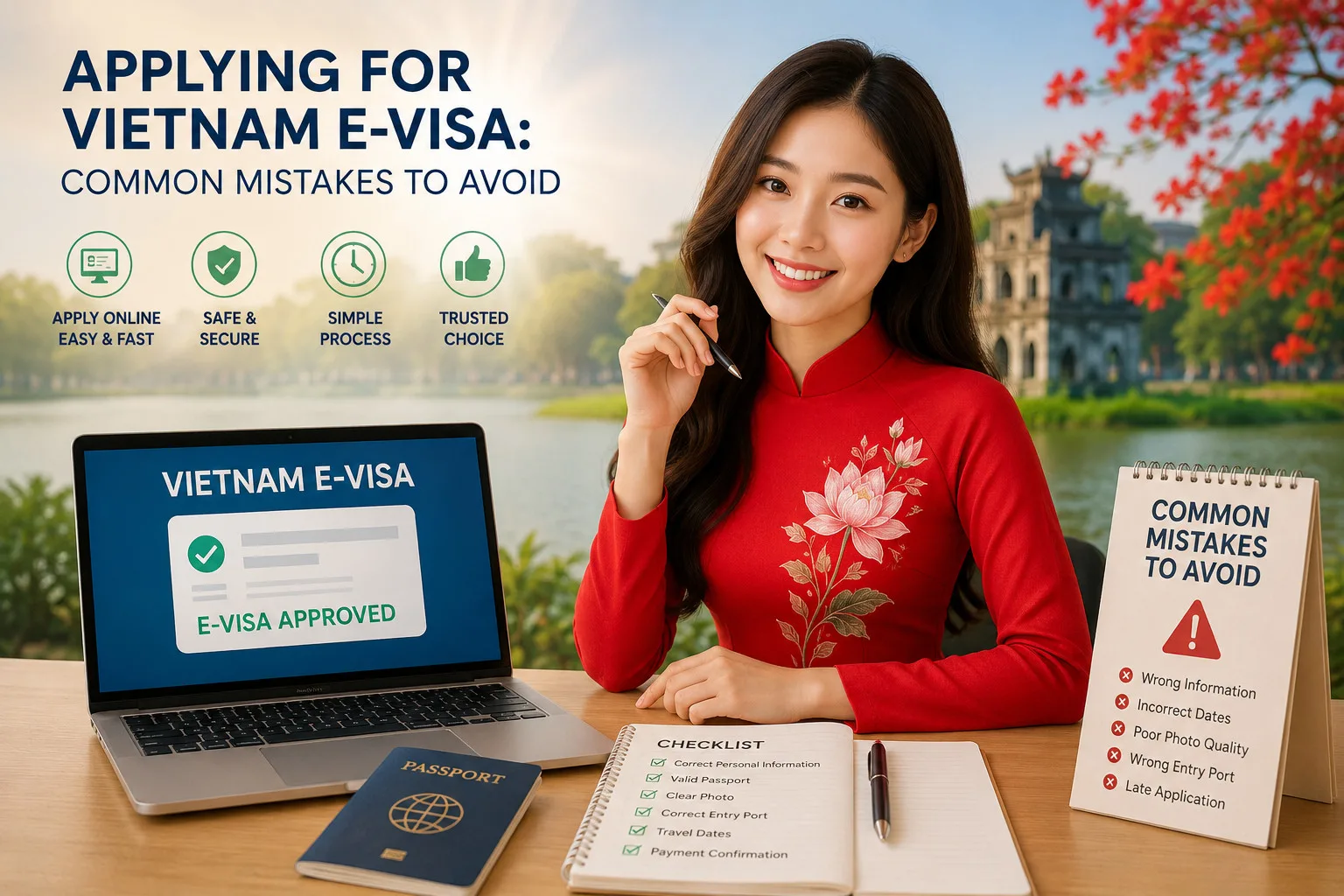
1. Entering Incorrect Personal Information
One of the most common Vietnam e-visa mistakes is entering personal information incorrectly. This includes spelling errors in the full name, wrong date of birth, incorrect gender, wrong nationality, incorrect passport number, or mismatched passport issue and expiry dates.
Your Vietnam e-visa information must match your passport exactly. If your passport shows your surname, given name, middle name, nationality, and passport number in a specific format, the same information should be entered carefully in the application form. Some travelers make mistakes because their passport uses multiple names, special characters, hyphens, or a different name order from what they normally use.
Before submitting your Vietnam e-visa application, check every field at least twice. Compare the application form with your passport data page line by line. Do not rely on memory. A single wrong digit in the passport number or a wrong birth date may cause your visa to be invalid for travel.
2. Uploading Poor-Quality Passport or Portrait Photos
Another major reason for Vietnam e-visa delays is uploading unclear or incorrect photos. The official e-visa application requires a passport data page image and a portrait photo. The portrait should show the applicant looking straight ahead and without glasses. The passport data page should be clear enough for the system and immigration officers to read all details.
Common photo mistakes include:
- Blurry passport image
- Cropped passport page
- Reflection or shadow on the passport
- Portrait photo with glasses
- Portrait photo taken from an old document
- Dark background
- Face not centered
- Edited or filtered photo
- File size or format problems
To avoid this mistake, take a new clear photo in good lighting. Make sure the full passport data page is visible, including the machine-readable zone at the bottom. For the portrait photo, use a plain background, face the camera directly, and avoid hats, sunglasses, or heavy shadows.
3. Choosing the Wrong Entry or Exit Port
Many travelers select the wrong airport, land border, or seaport when applying for a Vietnam e-visa. This can happen when travel plans change after submission or when applicants are not sure which port they will use.
Vietnam e-visa holders must enter and exit through approved international border gates that accept e-visas. If you choose the wrong entry point or arrive at a checkpoint that does not match your travel plan, you may face problems during check-in or immigration inspection.
Before applying, confirm your flight route, airport code, cruise port, or land border crossing. For example, travelers flying to Hanoi usually select Noi Bai International Airport, while those flying to Ho Chi Minh City usually select Tan Son Nhat International Airport. If your itinerary is not final, it is safer to wait until your travel route is confirmed before submitting the application.
4. Applying Too Late Before Departure
Although the official system states that e-visa applications are generally processed in 3 working days, applicants should not wait until the last minute. Processing may take longer if the application has errors, requires correction, falls during weekends or public holidays, or experiences system/payment delays.
A common mistake is applying one or two days before the flight and assuming the visa will arrive immediately. If the result is delayed, the traveler may be unable to board the flight.
To avoid this problem, apply as early as possible. A practical recommendation is to submit the application at least 7–10 working days before departure. For urgent travel, business trips, or emergency cases, applicants should prepare documents carefully and consider professional support to reduce the risk of mistakes.
5. Misunderstanding the Validity Period
A Vietnam e-visa is not automatically valid from the day it is issued. It is valid from the approved entry date shown on the visa. Travelers cannot enter Vietnam before the “valid from” date. They must also leave Vietnam on or before the “valid until” date.
Some applicants choose the wrong arrival date because of time zone differences, overnight flights, or connecting flights. For example, if your flight departs on May 10 but arrives in Vietnam on May 11, your entry date should match the actual arrival date in Vietnam.
To avoid this mistake, check your flight ticket carefully and use the arrival date in Vietnam, not the departure date from your country.
6. Selecting the Wrong Visa Type: Single Entry vs Multiple Entry
Vietnam e-visa may be issued for single entry or multiple entry depending on the applicant’s selection and approval. A single-entry e-visa allows one entry into Vietnam. If you leave Vietnam and want to return, you will need another valid visa unless you already have a multiple-entry visa.
This mistake is common among travelers who plan to visit Vietnam, then travel to Cambodia, Thailand, Laos, Singapore, or another country, and return to Vietnam again. If they apply for a single-entry visa, they may not be allowed to re-enter Vietnam with the same e-visa.
Before applying, review your full itinerary. If you plan to enter Vietnam more than once during the same trip, choose the multiple-entry option.
7. Using an Invalid or Nearly Expired Passport
Your passport should be valid for international travel and should have enough validity for your planned stay in Vietnam. Many airlines and immigration authorities may require the passport to be valid for at least six months from the date of entry, and it should have blank pages for entry and exit stamps.
A common mistake is applying with a passport that will expire soon, or applying with an old passport and later renewing it before travel. If your passport changes, your e-visa information will no longer match your travel document.
Before applying, check your passport expiry date. If you need to renew your passport, do it before submitting the Vietnam e-visa application.
8. Ignoring the Registration Code and Status Check
After submitting the Vietnam e-visa application, applicants receive a registration code. This code is important for checking the application status and downloading the e-visa result. The official e-visa lookup page requires information such as registration code, email, date of birth, and captcha.
Some travelers forget to save the registration code, enter the wrong email address, or assume the result will always arrive by email. This can create stress close to the departure date.
To avoid this mistake, save your registration code immediately after submission. Take a screenshot, write it down, and keep a copy in your email or cloud storage. Check your application status regularly on the official system.
9. Not Reviewing the Issued E-Visa Carefully
Receiving the e-visa does not mean you should stop checking. Once the e-visa is issued, review every detail on the PDF file carefully:
- Full name
- Date of birth
- Gender
- Nationality
- Passport number
- Valid from date
- Valid until date
- Entry type
- Entry/exit port
- QR code and document clarity
If the information is wrong, the e-visa may not be usable for boarding or entry. Some visa service providers explain that an issued e-visa with wrong information cannot simply be corrected and may require a new application.
Print a copy of your e-visa and also keep a digital copy on your phone. Make sure the PDF is clear and readable.
10. Providing Incomplete Travel or Accommodation Details
Applicants may be asked to provide travel information, address in Vietnam, and purpose of entry. Some travelers enter incomplete, fake, or inconsistent accommodation details. This may cause delays or refusal if the information appears unreliable.
If you have booked a hotel, use the correct hotel name and address. If you are staying with a company, friend, relative, or sponsor, make sure the address and contact details are accurate. For business travelers, the purpose of entry should match the supporting plan and invitation if applicable.
11. Making Payment Errors
The Vietnam e-visa application requires online payment. According to the official instruction page, the fee is paid after completing the application, and the government fee is listed for single-entry and multiple-entry e-visas.
Payment mistakes include using an unsupported card, closing the browser too early, unstable internet connection, or failing to confirm whether payment was successful. If payment is incomplete, the application may not be processed.
Use a stable internet connection, prepare a valid international payment card, and wait until the payment confirmation appears. Save the payment receipt or screenshot if available.
12. Confusing Official Government Websites with Service Websites
There are official government e-visa portals and there are also private visa service websites. Private agencies may provide support, document checking, urgent assistance, translation, consultation, or application handling, but they are not the same as the government immigration website.
The official Vietnam e-visa system is operated by the Ministry of Public Security and the Immigration Department. Travelers should understand whether they are applying directly through the official system or using a third-party support service.
If using a visa service, check service fees, processing support, refund policy, contact details, and what exactly is included. A reliable service should help reduce mistakes, not create confusion.
13. Not Preparing for Children or Family Applications
Families traveling with children should pay special attention to each applicant’s passport and visa information. Children with their own passports usually need their own visa application. Parents may make mistakes by entering the parent’s information in the child’s form, using the wrong passport number, or uploading the wrong photo.
When applying for a family, prepare one folder for each traveler. Name each passport scan and portrait photo clearly. Review each application separately before payment.
14. Assuming Visa Approval Guarantees Entry in All Cases
An e-visa allows the traveler to request entry into Vietnam, but final entry is still subject to immigration inspection. Travelers must comply with Vietnamese immigration regulations and present valid travel documents when entering and staying in Vietnam. The official FAQ also notes that foreigners must present valid residence documents to ensure compliance with immigration regulations.
You should carry:
- Valid passport
- Printed e-visa
- Return or onward ticket if required by airline
- Hotel booking or address in Vietnam
- Business invitation or supporting documents if applicable
15. Not Seeking Help When the Application Has a Problem
If your Vietnam e-visa application is delayed, incorrect, or requires correction, do not ignore it. The official e-visa website provides a support section where applicants can submit information about issues such as wrong application information and upload supporting files.
If your flight is close, professional visa support may also help you review the problem, prepare a new application, or advise the best next step depending on your case.
Quick Checklist Before Submitting Your Vietnam E-Visa Application
Before clicking submit, check the following:
- Passport is valid and not damaged
- Full name matches passport exactly
- Passport number is correct
- Date of birth is correct
- Nationality is correct
- Passport issue and expiry dates are correct
- Portrait photo is clear and without glasses
- Passport data page image is clear
- Entry date matches actual arrival date
- Exit date covers your full stay
- Correct single-entry or multiple-entry option selected
- Correct entry and exit port selected
- Accommodation address is accurate
- Email address is correct
- Payment is completed successfully
- Registration code is saved
Conclusion
Applying for a Vietnam e-visa is simple, but it requires accuracy. Most delays and rejections happen because of avoidable mistakes: wrong passport details, poor photo quality, incorrect travel dates, wrong entry port, late application, payment problems, or failure to check the issued visa.
To avoid problems, prepare your documents carefully, apply early, review every field before submission, save your registration code, and check the final e-visa PDF immediately after approval. If you are unsure about the process, have urgent travel plans, or need help correcting an application issue, using a professional Vietnam visa support service can save time and reduce risk.
A correct Vietnam e-visa application helps you enter Vietnam smoothly and start your trip with confidence.
Contact for Urgent Visa Support
- Hotline / WhatsApp / Zalo: +84986979330
- Email: support@vietnamevisaservice.vn
Note: vietnamevisaservice.vn is a commercial/personal website, NOT an official government website. We operate as a private agent and charge a fee for application services. If you do not require our simplified forms and visa application support, you can apply directly on the official government website.